CarbonGuru is designed to integrate into your existing workflows and surfaces — meeting you where you already are, and working for you in the background as directed.
Even with all the message-driven tools and spaces that have come online in personal and business life over the past 25 years — Slack, every social platform, and any productivity app with some kind of notification — email remains an active channel for a large part of the digital universe.
The design principle comes together in daily experience for CarbonGuru users as email workflow integration: automated scanning for business and personal expenses (in Gmail, after setting up secure access), asynchronous carbon footprinting and climate impact analysis for all the items identified in invoices and receipts, and composing baskets of matching preferred offsets for one-click purchase.
I had the chance to see that loop play out earlier this week.
This first screenshot shows the weekly summary I receive from the CarbonGuru platform listing purchases found by scanning my linked Gmail account: three emails from recognizable merchants — Apple and the Sony PlayStation Network.
The weekly purchase digest, delivered to my inbox. Click to enlarge.
Simply replying to the summary email triggers the detailed carbon analysis: fetching the messages via the Gmail API, feeding them to the full analysis pipeline, getting quotes for matching offsets, and more.
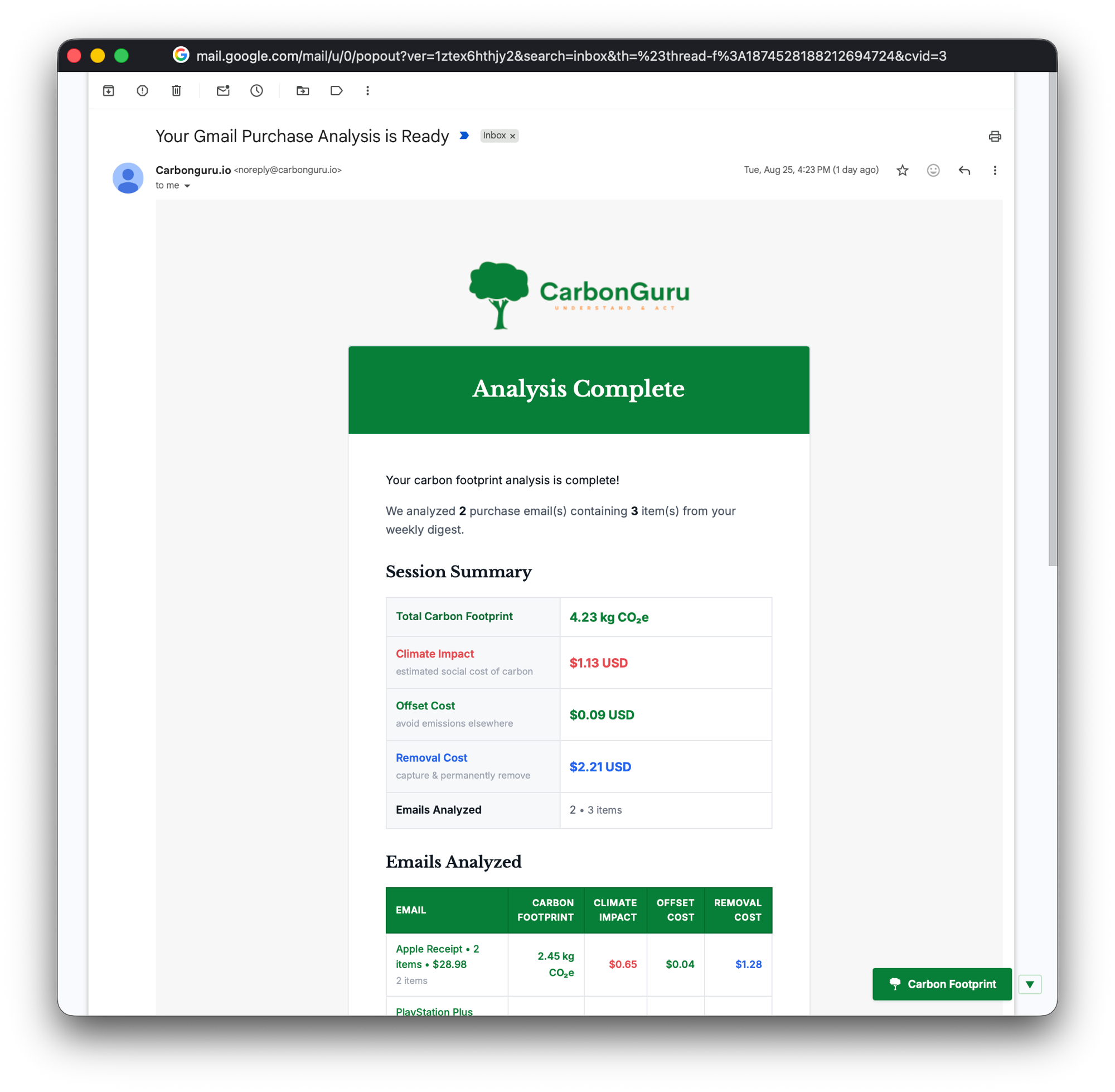
This second image shows the completed carbon footprint analysis returned to my inbox: three items — media services and subscriptions — identified, with a total estimated footprint of 4.2 kg of carbon. That’s $1.13 of climate impact I can offset with my preferred carbon projects and suppliers for the raw sum of $0.09.
This high ratio of avoided impact to low cost of avoidance — approximately 13x — is typical. Also typical is the low proportion of offset cost as a percentage of the items’ purchase price: here less than one-quarter of one percent.
The completed analysis, returned by email: footprint, climate impact, and the cost to act. Click to enlarge.
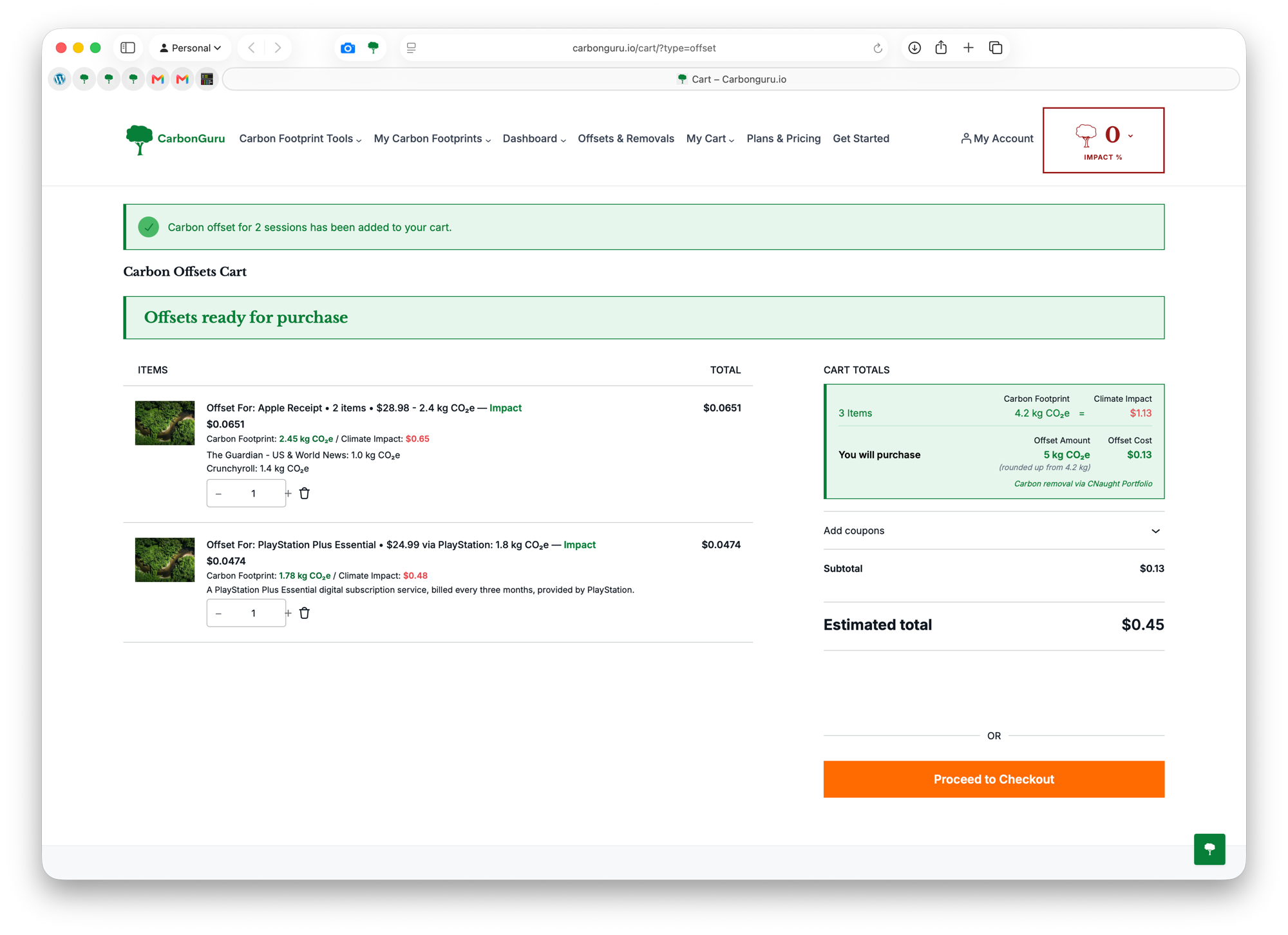
Clicking the Offset CO₂e button in the results email populated my CarbonGuru cart with a matching set of offsets. The screenshot shows the rounded amount of carbon offsets purchased in whole kilograms as 5 kg, for a cost of — wait for it — $0.13.
One click from the email: a cart of matching offsets, ready for purchase. Click to enlarge.
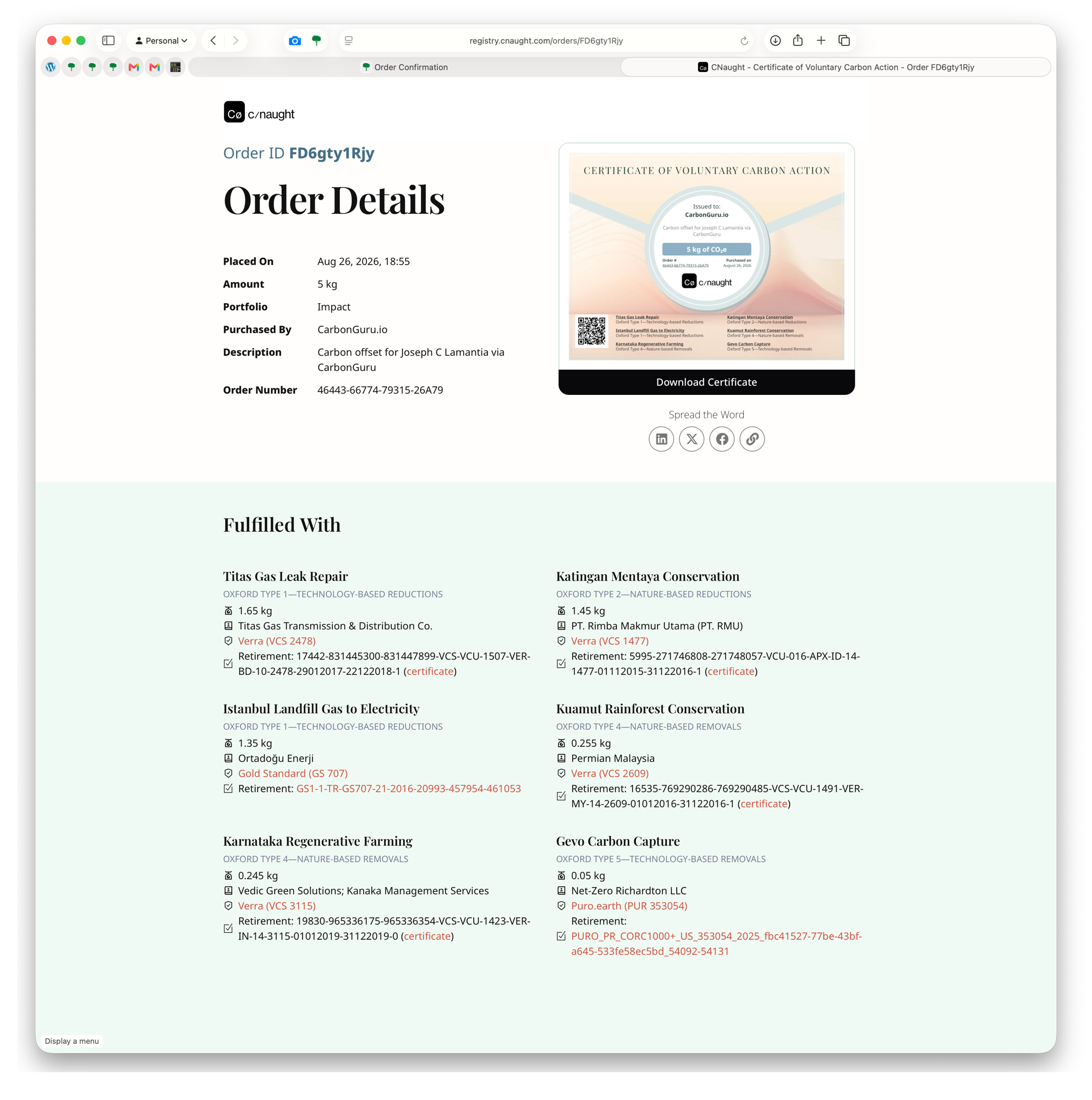
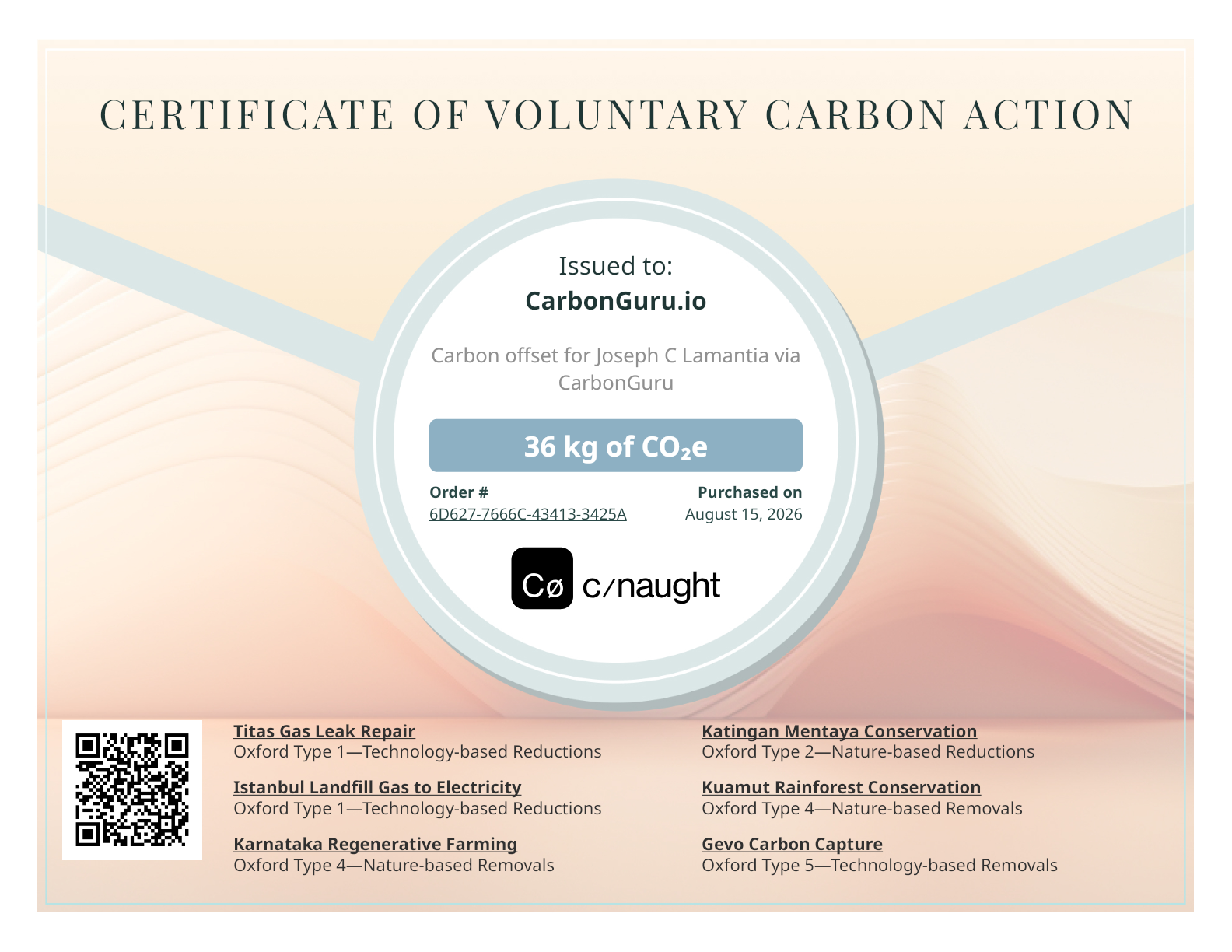
Here’s the certificate for the retired credits.
The registry record and certificate for the retired credits — six projects, each with its verified retirement serial. Click to enlarge.
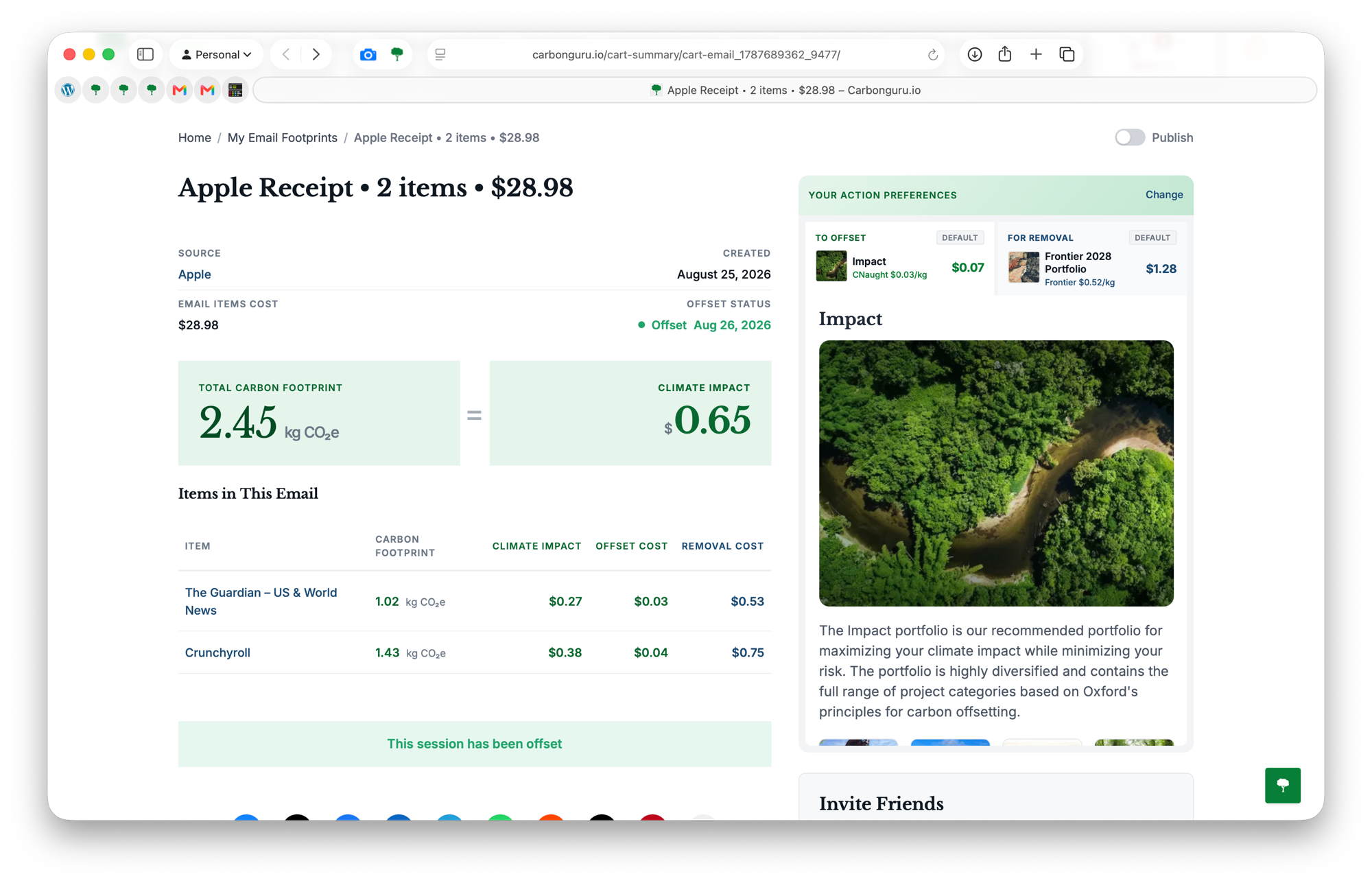
And the carbon footprint details, showing the individual footprints as offset today.
The footprint detail page after purchase: per-item footprints, marked offset. Click to enlarge.
It’s a complete analysis and offsetting workflow embedded into the existing email channel and surfaces.
Out of Office: I Offset My AI With AI for 96 Cents, Over Breakfast
August means vacation for my family, and, though I’m not fully out of the office — b/c *cough* …living the start-up dream, in the age of 24-hour AI-powered product development… — some regular business is backgrounded for a bit, including detailed invoice review.
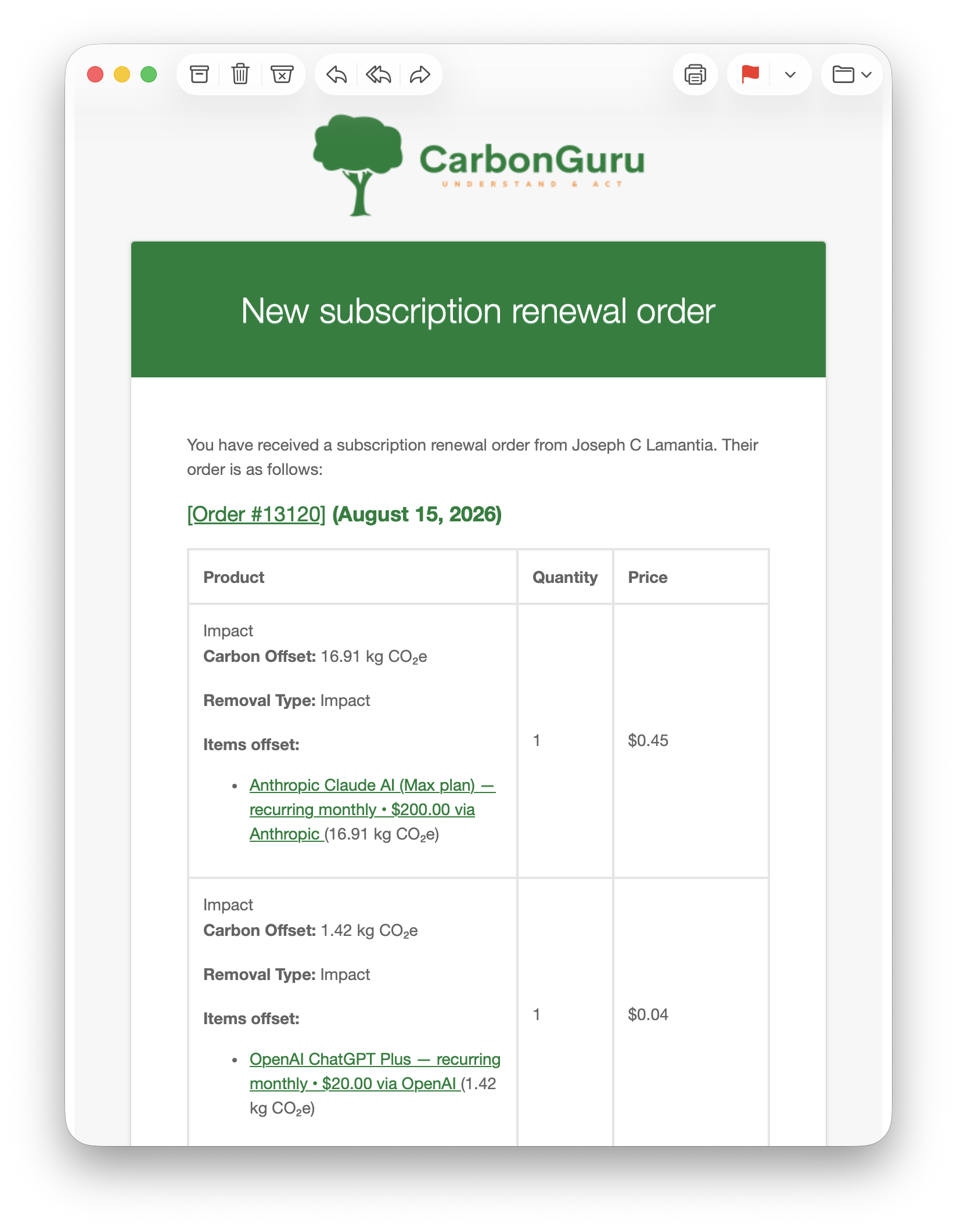
The renewal notice — 36 kg CO₂e, $0.96. Click to view the full email.
So, while planning sightseeing over breakfast a few days ago, I was pleasantly surprised to see a ‘CarbonGuru.io Automatic renewal notice’ in my inbox, for an upcoming offset order covering the climate impact of Claude Code, ChatGPT, DreamHost, and related services — 36 kg of CO₂e in total, for a cost of $0.96.
To be honest, I’d forgotten about setting up recurring offsets for these. One of the early tests of CarbonGuru’s automated offsetting via agent was a session at the beginning of the summer using Claude connected to the CarbonGuru MCP server to estimate the carbon footprint of some of the AI, application hosting, and other digital services that power the platform itself (screen recording here). After confirming the MCP tools and end-to-end automation functionality worked, I’d posted the recording, and gone on to building other features.
Thirty days later, between sips of coffee, I was relieved to realize that I’d (accurately) assumed I would forget to use my own product — yes, I know… — during our upcoming vacation, and taken the agent’s recommendation to make the offsetting for several of CarbonGuru’s regularly billed AI tools a recurring subscription, instead of a one-time purchase. Effortless, affordable, automated climate impact management is literally on the CarbonGuru homepage, so as a builder, it’s a tremendous relief gratifying when your product actually works genuinely delivers as claimed.
Large enterprises consider this kind of exercise vanilla carbon accounting, typically something that dedicated in-house sustainability and finance teams take on; often using a combination of specialized tools and licensed data sets for the detailed LCA calculations, then integrating with an established ERP suite and a compliance-focused SaaS platform for the scaled carbon accounting and reporting.
Mid-sized firms that are conscientious about managing environmental impact might take this on as one instance of a quarterly or semi-annual exercise in ‘Understanding our impact’, passing the new question of carbon footprints generated by the AI services they’re experimenting with to a sustainability consulting provider, which consolidates data across silos to estimate operational footprints, and composes bespoke offsetting programs for clients.
For most technology product and service startups — and for small businesses in general — the ability to accurately estimate carbon footprints and climate impact for a rotating basket of AI and software tools, and then automatically set up recurring offsetting on a predictable schedule for the ones that persist in the stack, is wholly new. CarbonGuru combines LCA, carbon accounting, and offset sourcing and acquisition with agent-based automation to integrate all of these directly into existing admin workflows without additional friction to close the gap for you — even when on vacation.
In my case, from the customer perspective, it meant I could go back to a proper vacation task: looking for ways to keep my kids off their screens for the rest of the day, while seeing a foreign city.
Try CarbonGuru.io for free — whether you’re on vacation, doing business, or both:
The combined footprint for these services is 36 kg CO₂e. To see detailed analysis on all the line items — the ChatGPT Plus subscription has a footprint of 1.42 kg CO₂e, roughly comparable to a bag of potato chips — here are some of the carbon footprints mentioned:
Claude Code Max — 16.91 kg CO₂e · similar footprint to 1× sleeping bag
ChatGPT Plus — 1.42 kg CO₂e · similar footprint to 1× bag of potato chips
DreamHost — 12.68 kg CO₂e · similar footprint to 1× wireless headphones
Figma — 1.51 kg CO₂e · similar footprint to 1× USB-C cable (6 ft)
The individual carbon credits and retirements include a variety of locations, methods, and registries around the globe, incidentally reflecting the reality that my carbon is also your carbon, and anyone’s offset benefits everyone, since we all share the same atmosphere.
Here are three of the individual carbon offsets purchased in this most recent round (every order is matched automatically to offsets each month):
I hope this lands as good news for you about the climate: nowanyone can make the impact of everyday life and work positive — for literally pennies.
Please say hello to CarbonGuru.io: a carbon footprint analysis platform that measures the CO₂e impact of anything you buy and do for life or business in seconds, and lets you offset and remove carbon with positive impact immediately, for just a few cents. CarbonGuru works directly from your browser and your inbox (mobile, too), as part of your everyday buying and workflows, and you can automate everything it does with your regular AI agents and tools by asking.
Why build this now? Most of us want to do something about the climate, but don’t have an easy, affordable way to act that fits into ordinary life and work. CarbonGuru started as an AI + climate-tech exploration with the simple goal to find and do something useful and positive with new tech.
It evolved into a consumer product and SMB platform designed to serve folks around the world. I think of it as a look at how AI-powered automation can share the power of well-established environmental science with everyone, and (hopefully) give people a genuine sense of agency about something that matters to them, but has been largely confined to the horizon of policy and politics.
The first release is open now: Early customers have set up offset subscriptions for regular household spending — groceries, family travel, and activities like kids’ camps. (Watch me buy some tea and offset it right away: https://www.youtube.com/watch?v=IglsrwefwBY).
As an AI-powered startup, I use it to automatically track and offset the carbon footprint of the various AI tools and technology services that power the product and platform itself. (Watch a live session analyzing and offsetting business purchases with Claude: https://www.youtube.com/watch?v=9Ahh3LniQjY)
And business-tier customers are running higher-volume analysis of transactions and operations for carbon footprint and climate impact planning and reporting.
Like all founders, I (inevitably…) asked my Mom (Hi Mom, if you’re reading this!) to try it.
She said the simple experience of seeing the footprint of something from her everyday life for the first time, then balancing the climate impact with a button-push was actually powerful: it made her feel like she could do something.
Please try for yourself. Share it with friends, family, and colleagues. Consider investing and helping CarbonGuru grow to its full potential.
I’ve posted the recording and supporting slides for Part four of the ‘Flying Blind’ case study series, Long Term Outcomes. This installment uses the business strategy context identified in Part 3 – Foundations to consider cumulative efforts at building out new analytics products, categories, and portfolios for B2B / enterprise in the pre-GenAI era of machine intelligence. The retrospective covers products and services my product development group originated, as well as representative related and competing offerings from relevant categories across the product landscape, and looks briefly at one company addressing the whole value chain.
Summary:
A 10-year retrospective covering long-term business and product strategy outcomes for new products / portfolios / categories in the AI and business analytics space. This is the fourth installment of an extended case study on B2B / enterprise product strategy titled ‘Flying Blind On a Rocket Cycle: Customer-Centered Product Strategy For Machine Intelligence’ originally offered at ProductCamp Boston 2024.
Part 4 topics:
1. Strategy foundations recap
2. Business strategy and product context: analytics products for emerging spaces
3. Review of product strategy, product investment cycles, and product outcomes
4. Review of business strategy cycle and outcomes: new product categories, machine intelligence product landscape, value chain
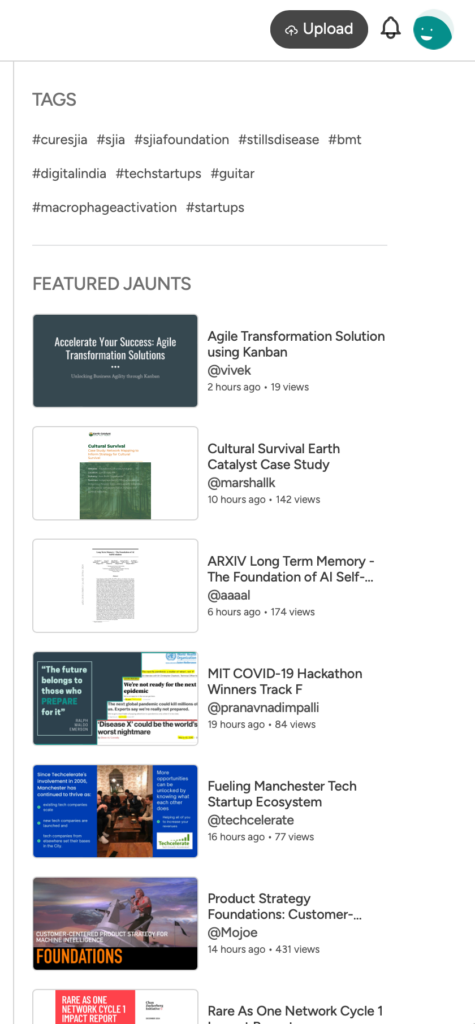
Subtitle this post ‘everything old is new, again’: Rashmi Sinha, Jon Batelle, Amit Ranjan just launched their new (new) social document sharing service Jaunt. I was an early Slideshare user – still am, given the lack of alternatives until two days ago… – and it’s exciting to see a relevant, experienced team looking at this space.
The overview:
Jaunt is a social platform for sharing and discovering documents & presentations. Our mission is to spark the sharing of ideas and expertise, bringing people together through meaningful content.
Our Vision
In today’s landscape, creators have dedicated platforms for every medium – videos flourish on YouTube and TikTok, photos shine on Instagram. Yet creators of documents and presentations lack a space to share their work and find their audience.
Recognizable gap in the tool chain / missing infrastructure = check.
Documents are the backbone of professional communication – they’re how we share groundbreaking research, articulate business strategies, and present innovative ideas. Whether you’re publishing a scientific paper, outlining a business plan, crafting a startup pitch, or sharing a creative manifesto, your work deserves a dynamic platform where it can reach and resonate with others.
Generalized social behavior obstructed by pervasive platform decay (*cough* enshittification) means new era = check
Reimagining Documents in for Today’s Social Web
We knew that bringing documents into the social era meant solving the mobile challenge. So we rebuilt the document experience from the ground up. On Jaunt, you can seamlessly scroll through documents and presentations, and swipe right to discover related content. An intuitive, web-based experience that works on any device.
And… Experience-based value proposition suited for evolving media = check.
I think the early days of a new service can be especially interesting, rewarding, and exciting for everyone involved – but then, I like to see new things evolve in real time. If a product is successful, it inspires new language: long before tweet turned into a digital noun and verb: Hoovering became how people identified vacuuming (at least in the UK). My first Jaunt is embedded below. Let’s wish them good luck with naming a new behavior.
I just posted the recording and supporting slides for the new part three of the ‘Flying Blind’ case study series on building out new analytics products, categories, and portfolios for B2B / enterprise in the pre-GenAI era of machine intelligence.
For those following via these postings, on publishing the last installment, I’d expected this part 3 to be ‘a concluding / bookend segment that summarizes the business strategy perspective, given the close linkage to product strategy thats’s set up at the beginning of this story.’
Turns out a brief dive into sharing some product strategy foundations made sense as the next step, as it nicely sets a meaningful – erm – foundation for the full long-term retrospective on business and product strategy coming in part four.
Here’s the summary:
“This talk shares product strategy foundations, as the third installment of the extended case study ‘Flying Blind On a Rocket Cycle: Customer-Centered Product Strategy For Machine Intelligence’ originally offered at ProductCamp Boston 2024.
Part 3 topics:
1. A model and archetype for product strategy
2. Clarified relationship linking business strategy and product strategy
3. A working definition for product strategy
Look out for a few new cameos in the expanding cast of characters, including: Moana (and Maui), George Carlin, Carl Jung, and leading thinkers on business, architecture & urbanism, and economics.
I’ve recorded voice-over narration for my ProductCamp Boston 2024 session, Flying Blind On a Rocket Cycle: Customer-Centered Product Strategy For Machine Intelligence.Originally presented live for a cozy in-person audience, the driving (*cough* – the Italian word for driver is ‘pilota’…) concept behind this case study format was recreating the experience of doing product strategy for an emerging enterprise technology space in real time, by offering the audience a sort of co-pilot’s (*cough* – not a GenAI co-pilot…) view through the windshield for shared learning purposes.
This particular story of building out new analytics products, categories, and portfolios happened a while back in tech terms, in the pre-transformer era of AI, when deep learning was new.In addition to being strongly enterprise focused, unlike much of the readily available material on product strategy, it’s timely on more than one level thanks to abundant parallels with our current AI-focused moment.
Recall there was considerable debate at the time around the core concepts, expressed via rhetoric like ‘machine learning is just glorified statistics’.(Search for this, if you’re feeling nostalgic for richly sardonic memes and gifs focused on IRML, often shared via pre-lapsarian social platforms.)Now we’re having a very public global debate about whether GenAI is [also] a new and transformative general purpose computing paradigm, built on probabilistic computing, or just a stochastic parrot that’s been wildly scaled up in terms, of compute, data, etc. for short-term gains. The rhetoric now takes what used to be technical perspectives at heavily niche conferences – NIPS before Zuck, anyone…? – and makes them the subject of public conservations about the stock market, featuring well-known AI academic and industry leaders and tech CEO’s of all types talking live on leading business television programs during investors’ liquid lunch windows.
Yes, as you may be thinking, these are in fact explicitly product strategy conversations happening out loud – with a hefty dollop of geo-politics… – which I’ll come back to another time.
For easy listening — we went quite fast in the first-run live talk — I’ve added bit more depth to the narration, and shared the recording in two parts.[And I think I’ll add a concluding / bookend segment that summarizes the business strategy perspective, given the close linkage to product strategy thats’s set up at the beginning of this story.]
Thanks for listening, and please share your perspectives.
Part 1
Part 2
For reference, here’s the original session description:
“Using the product strategy cycle as a guide, this session shares a case study on the growth and evolution of B2B product portfolios driven by machine intelligence for a leading SaaS product maker.This case study reviews a series of new product efforts; outlines the methods, tools, and practices that powered opportunity assessment, product discovery, and strategic planning; traces the evolution of product portfolios; and considers business outcomes from building and growing a portfolio of new analytics products and services for Oracle over the course of several years.”
This case study illustrates and demonstrates:
Crafting customer-centered product strategies for new machine intelligence / AI / ML technologies
Building and evolving customer-centered products and portfolios, and new product categories
Establishing effective, innovative, customer-centered product strategy capabilities and practices for emerging spaces
Organizations need to move beyond viewing AI deployment as purely a technical challenge. Instead, they must consider the human impact of these technologies. Long before AIs achieve human-level performance, their impact on work and society will be profound and far-reaching. The examples I showed —from construction site monitoring to virtual avatars—are just the beginning. The urgent task before us is ensuring these transformations enhance rather than diminish human potential, creating workplaces where technology serves to elevate human capability rather than replace it. The decisions we make now, in these early days of AI integration, will shape not just the future of work, but the future of human agency in an AI-augmented world.
In a word, YES. I’m inclined to break this down further, following the thinking on the individual elements – but for now it’s enough. The call is timely, given the choices we’re making in the US (and in many other countries) about our vision of the future.
Now, if we knew where to find people – perhaps even professionals – who focus on ‘the human impact of technologies’. 😉
Many thanks to all the organizers, volunteers, hosts, participants, and everyone who helped make ProductCamp Boston 2024 happen – it was great to see a strong, local, community-powered event like this ‘back online’!
I’ve posted the slides from my session, “Flying Blind On A Rocket Cycle: Customer-centered Product Strategy for Machine Intelligence” over at Slideshare (an original Web2.0 service that’s still active…). We covered ~3 years of hands-on effort building a portfolio of advanced analytics and ML / AI products, services, and infrastructure in just 30 minutes, using the conceit of ‘looking through the windshield’ at oncoming business and customer questions in real-time to recreate the experience of learning to navigate the product strategy cycle. I’m positive there are further questions, thoughts, and comments, and I welcome feedback from folks who were in the room, or who follow along now.
Here’s the session overview:
Using the product strategy cycle as a guide, this session shares a case study on the growth and evolution of B2B product portfolios driven by machine intelligence for a leading SaaS product maker. This case study reviews a series of new product efforts; outlines the methods, tools, and practices that powered opportunity assessment, product discovery, and strategic planning; traces the evolution of product portfolios; and considers business outcomes from building and growing a portfolio of new analytics products and services for Oracle over the course of several years.
This case study illustrates and demonstrates:
Crafting customer-centered product strategies for new machine intelligence / AI / ML technologies
Building and evolving customer-centered products and portfolios, and new product categories
Establishing effective, innovative, customer-centered product strategy capabilities and practices for emerging spaces
This was my first longer-form public talk since 2018, when I shared an overview and retrospective on building product a strategy function for emerging spaces at UX Strat. (That talk references some of the same delivered products, while emphasizing how to approach and engage with different stages of product and technology lifecycles.)
As a nod to the (pre-Xitter [with proper pronunciation…]) past, here’s the ‘going on stage’ tweet from that last talk:
We are pleased to welcome Joe Lamantia to the UX STRAT stage to talk about “Pioneering Product Strategy in Emerging Spaces,” in Providence RI, Sept 16-19: https://t.co/HnZH4UN7P3. UX STRAT is a single-track conference about strategic UX / Product design.#uxstratpic.twitter.com/kqIb4rlVAZ
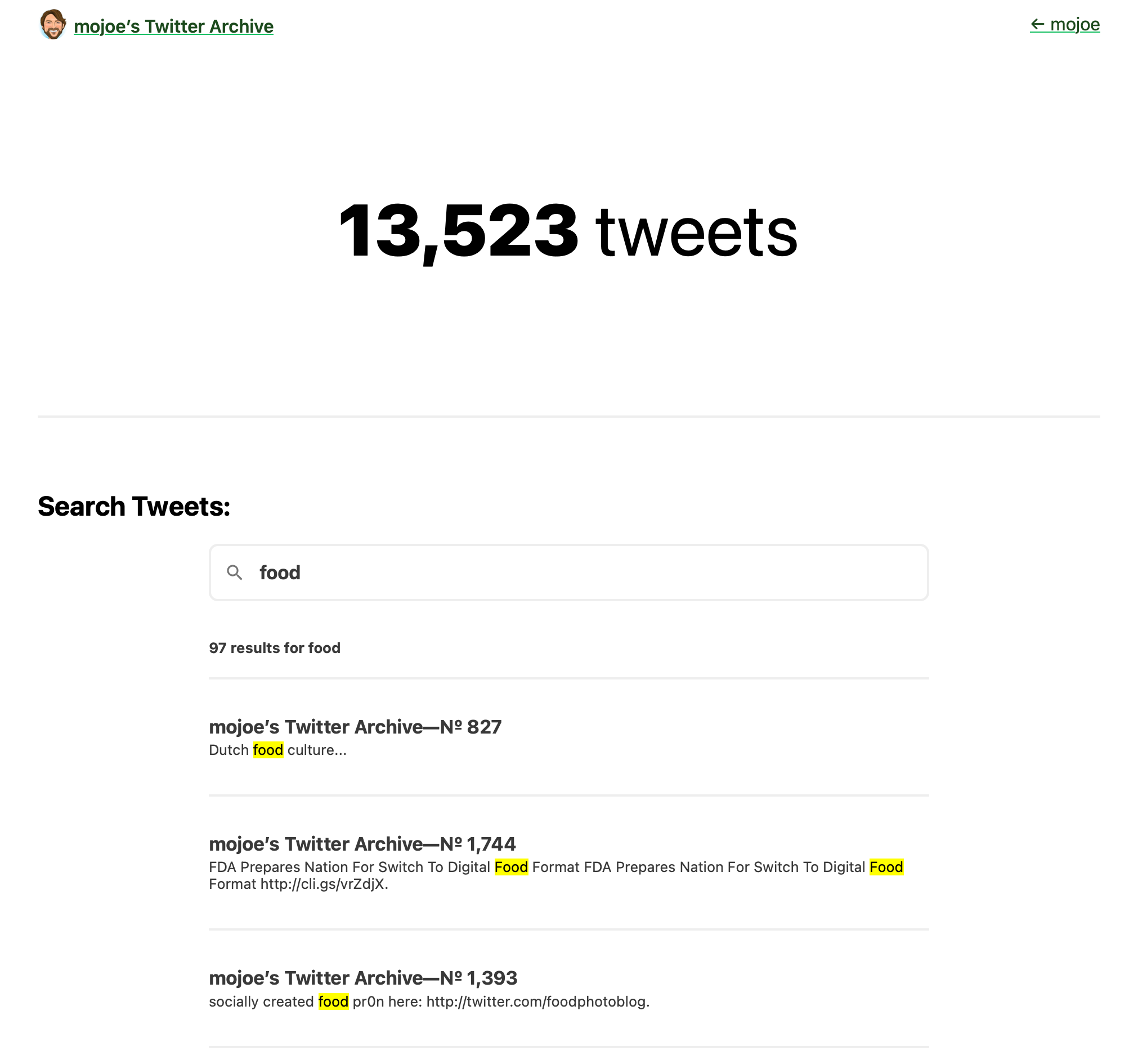
In a narrow sense, my account is ‘just a collection of tweets’. But, thanks to the comparatively long span of time I was active, it also serves as a defacto window on my explorations and progression through several different professional eras. The changing shape of my social and interest graphs, and the record of public sharing and back-and-forth interactions, encode a set of meaningful relationships and participation in a long-standing global community. In short, it’s a slice of history worth ‘saving’, in some form.
In the intervening 18 months, I’ve realized these postings and conversations offer largely historical perspective and value for me – and surely only peripheral utility for anyone else – so it’s sufficient if I have control over the account and the data going forward. In practical terms, this means publishing an archived copy of the account here, on a platform I control, with the ability to delete or de-activate the dormant original as needed. I’ll leave the mothballed account as a bridge to the rapidly growing fediverse, for interested folks.
As a benefit of the DIY builder approach to a Twitter archive, I spent more time in the code-focused web application spaces I first re-touched as part of reconstructing my original blog, and setting up JoeLamantia.org as forward-looking platform. I don’t see returning the strong developer focus of my very first technology / Internet roles, but learning basics of wp cli, working with python and javascript, and navigating text data manipulation was a rewarding return to my roots.
In terms of outcomes from building this kind of historical corpus, in addition to easily citing my own tweets – something to be discrete with – it can be fun to see what’s in there. A friend used the lightweight query capability to identify tweets with ‘design’, and got back this summary from ChatGPT:
“Here is a summary of the provided tweets from mojoe’s Twitter archive, focusing on the 610 results related to “design”:
Design Thinking and Innovation:
Several tweets reference articles and resources on design thinking, such as “The OTHER Design Thinking” by Humantific and “Innovation Matrix: Design-Led Innovation from Philips.” These tweets suggest an interest in different approaches and frameworks within design thinking.
Design-Related Discussions:
Interaction with other users about design, such as a mention of a “design fiction lecture” and a critique of certain design practices as “design-washing” and “data-washing,” indicating a critical view of superficial design implementations.
General Themes:
The remainder of the tweets covers a broad range of topics, including political opinions, social commentary, and personal thoughts on various issues. These tweets do not directly relate to design but provide context on mojoe’s broader interests and viewpoints.
Overall, the tweets reflect a strong engagement with design thinking and innovation, alongside a diverse array of other topics.”
As quick summaries go, this is not bad. It’s not the most insightful, but it spotlights some of the more distinctive and impactful (read, condensed, and sometimes provocative…) instances of phrasing that twitter’s shorter-form conversation architecture encouraged. However, as soon as analysis moves beyond gauging and describing purely functional aspects like framing, contents, structure, etc., you’re in the ambiguous territory of ‘aiming for good taste‘. Of course, good taste is ultimately the goal of most forms of assessment – including specialized critique – but it’s also something to be careful to ask for from an LLM, even when you’re feeling generous about their current capabilities.
With a corpus of meaningful linguistic data I’m familiar with as the originator, I’m (moderately?) inclined to keep exploring new LLM-based tools to understand where they’re relevant.